Plan transport around the itinerary, not the headcount. Confirm your staging point, name the vehicle type for each leg, and flag the two or three moments in the day that cannot slip. Everything else, from vehicle mix to contingency capacity, follows from that. Kler Transport publishes indicative rates on its booking page if you need a quote to work from while you build the plan.
TL;DR:
- Building a transport plan around the itinerary accounts for fixed moments like shift changes and site meetings, reducing delays and last-minute adjustments.
- Confirming vehicle entry points, PPE requirements, route details, and driver instructions before the visit prevents access delays and simplifies on-site coordination.
- Choosing vehicles based on the role, internal movement challenges, and staging discipline ensures smooth internal transfer and reduces congestion or maneuvering issues.
- Maintaining a single, live schedule with clear communication protocols and contingency plans minimizes delays caused by miscommunication or unforeseen disruptions.
- Locking down key elements such as the itinerary, staging, vehicle capacity, site rules, and post-visit debriefing significantly improves on-time performance and operational efficiency.
Table of Contents
- Build the factory visit transport plan around the itinerary
- What pre-visit checks prevent access delays?
- Which vehicles fit which roles on a factory visit?
- How do you keep a factory visit on schedule?
- What should you capture after a factory visit ends?
- How does a specialised chauffeur provider support factory visits?
- How do you align transport with production schedules?
- What communication protocols keep transport, staff, and visitors aligned?
- What regulations apply to transporting visitors on industrial sites?
- What health and safety measures matter for transporting factory visitors?
- Perspective: a compact planner checklist for transport leads
- How Kler Transport can help you execute the plan
- Sources
- FAQ
Build the factory visit transport plan around the itinerary
A transport plan built around a headcount fails the first time a shift changeover or a health and safety briefing runs long. A plan built around the itinerary survives it, because every vehicle movement is already tied to a specific moment in the day rather than a rough estimate of “morning” or “afternoon.”
Start by mapping every movement, not just the obvious ones:
- Arrival at the pickup point and transfer to the facility
- Site staging (where the group waits before entering, and for how long)
- Internal transfers between buildings, floors, or production lines
- Off-site lunches or supplier meetings squeezed into the middle of the day
- The return journey, including any drop-offs that split the group
Once the movements are mapped, identify which ones are genuinely fixed. A production-line walkthrough timed to a specific shift, or a slot with a facility director who has fifteen minutes between meetings, cannot absorb a fifteen-minute delay. Build time buffers and priority vehicles around those moments specifically, rather than spreading a generic buffer across the whole day.
Assign named roles early: an escort who stays with the group, a single point of contact for the driver, and someone responsible for luggage or AV equipment. Vague ownership is how a laptop bag ends up in the wrong vehicle.
What pre-visit checks prevent access delays?
Most transport failures on factory visit days trace back to something that was never checked, not something that went wrong on the road. Run these checks before you lock the itinerary:
- Confirm vehicle entry points and loading zones. Ask the facility directly which gate vehicles use, where drop-off happens, and whether parking is limited on-site.
- Check PPE rules and group-size limits. Some facilities issue hard hats or safety glasses on arrival; others expect visitors to bring their own. Reserve PPE in advance if the facility requires it.
- Walk the route or request a site plan. Maps miss hazards, blocked corridors, and shared emergency egress paths that only show up on foot.
- Brief drivers on idling rules, exits, and an on-site contact. A driver who knows who to call if the group runs long saves you a frantic phone search later.
Booking lead times vary by facility. Freshening Industries asks for a reasonable advance notice and a minimum group size for its 80-minute experience tour, while Hyundai Motor Group Innovation Centre Singapore runs 90 minute guided tours with booking slots that fill and a site that sits a 14-minute walk from the nearest bus stop, which matters if your transport plan assumes drop-off right at the door.
Pro Tip: Call the facility’s tour coordinator directly rather than relying on a public booking form. Lead times and PPE rules often change between seasons and rarely make it onto the website.
Which vehicles fit which roles on a factory visit?
Vehicle choice should follow the role someone plays that day, not just the total number of seats you need to fill. A senior visitor meeting the plant director gets a sedan. A working group touring the production floor gets an MPV or minibus. A delegation of forty needs a coach for the transfer and something smaller for movement once inside the gates.
- Sedans for executives, VIP guests, or anyone with back-to-back meetings either side of the visit
- MPVs for small working groups who need to move together and carry equipment
- Minibuses or coaches for larger delegations making a single transfer to and from the site
- Internal shuttles for movement between buildings once the group is already on-site
Internal campus roads are where plans go wrong. Coaches that handled the motorway transfer perfectly often cannot manage tight turning radii, narrow internal roads, or loading dock access once inside the perimeter. Confirm vehicle suitability for internal movement with the facility’s own operations team rather than assuming a coach will fit because it fit the car park.
Staging discipline matters as much as vehicle choice. Nominate one visible staging point, produce a printed or phone-based manifest listing every passenger and their assigned vehicle, and pre-assign boarding order so nobody is milling around working out which minibus they’re on. Groups larger than twelve to fifteen people move faster split into subgroups with smaller shuttles for internal legs than they do crammed onto one coach navigating a loading bay.
How do you keep a factory visit on schedule?
On the day itself, the plan lives or dies on whether everyone is working from the same information. That means one live itinerary, one central contact number, and vehicle tracking where the fleet supports it. If your driver, your escort, and the facility host are each working from a different version of the schedule, delays compound instead of getting caught early.
Before wheels turn, run a driver briefing covering:
- The confirmed route and any known road works or access restrictions
- Where to park and who to call on arrival at the facility
- Privacy and security protocols, particularly around photography and phone use near production lines
- Emergency procedures and the nearest exit points inside the facility
Agree your contingency actions before you need them, not while you’re standing in a car park working them out live. That means:
- An alternate route pre-checked for the return leg in case of road closures
- A spare vehicle on-call, especially for groups larger than twenty
- A plan for staggered subgroup departures if part of the group finishes early
- A named escalation contact who can make a call without waiting for sign-off
Delegation transport planning treats every leg as a managed guest experience rather than a logistics box to tick, and that mindset is what keeps a visit moving when something inevitably shifts. The group that recovers fastest from a delay is usually the one that decided what “recovery” looks like the week before, not the morning of.
What should you capture after a factory visit ends?
The debrief is where next time’s plan gets built, and it takes fifteen minutes if you do it while the day is still fresh.
- Record actual arrival and departure times against the plan, noting the cause of any delay
- Ask drivers, the facility host, and the visiting team for quick feedback on what slowed things down
- Update your site access notes with anything new: a gate that moved, a PPE rule that changed, a parking bay that’s now closed
- Reconcile transport invoices against the confirmed booking, and check no-show or late-cancellation policies before disputing a charge
Facilities like Yakult Singapore publish booking windows up to 90 days out and confirm by email, which is worth logging in your notes if you plan to bring another group back within the year. Small process fixes here save far more time than they cost.
How does a specialised chauffeur provider support factory visits?
A chauffeur provider that understands corporate site visits removes several of the failure points already covered: uncertain staging, unclear vehicle-to-role matching, and drivers who don’t know the site. Meet-and-greet at the pickup point, luggage handling for equipment or samples, and flexible hourly charters that absorb a schedule running long are the practical services that map directly onto the checklist above.
A driver briefed on the site’s parking restrictions and emergency exits before departure is not a courtesy. It’s the difference between a group that walks in five minutes late and one that stands at the wrong gate for twenty.
Spare-vehicle options matter more than most planners budget for, particularly for delegations over twenty people where one mechanical issue or one late VIP arrival can otherwise cascade through the whole day. A fleet spanning sedans through minibuses and coaches lets a single provider cover the executive leg and the working-group leg of the same visit without a handover between suppliers.
How do you align transport with production schedules?
Factory operations run on fixed timelines that transport planning has to respect, not the other way round. A shift changeover, a scheduled maintenance window, or a production run that cannot pause for visitors will always take priority over a group’s arrival time, so the transport plan needs built-in slack rather than an assumption that the facility will flex.
Get the facility’s operations contact involved before you finalise pickup times, not after. Ask directly which windows are flexible and which are not: a line manager will usually tell you that the 10am changeover is untouchable but that the 2pm slot has thirty minutes of give either side. That single conversation reshapes your whole schedule far more usefully than a generic itinerary template.
Commissioning and plant visits tied to fixed production timelines show how quickly a late transport arrival can push back the actual production work the visit was meant to observe, turning a transport delay into an operational one. That’s a different order of problem to a group standing around in reception.
Build in a standing check-in with the facility’s floor supervisor or tour coordinator on the morning of the visit, even if everything was confirmed the week before. Production schedules shift for reasons that have nothing to do with your visit, and a five-minute call at 7am can save a rescheduled afternoon. Treat the facility’s operational rhythm as the fixed variable and your transport plan as the one that adapts around it, never the reverse.
What communication protocols keep transport, staff, and visitors aligned?
Three groups need to be talking to each other on visit day: the transport team, the factory staff, and the visitors themselves. Most delays happen in the gaps between these groups, not within any one of them.
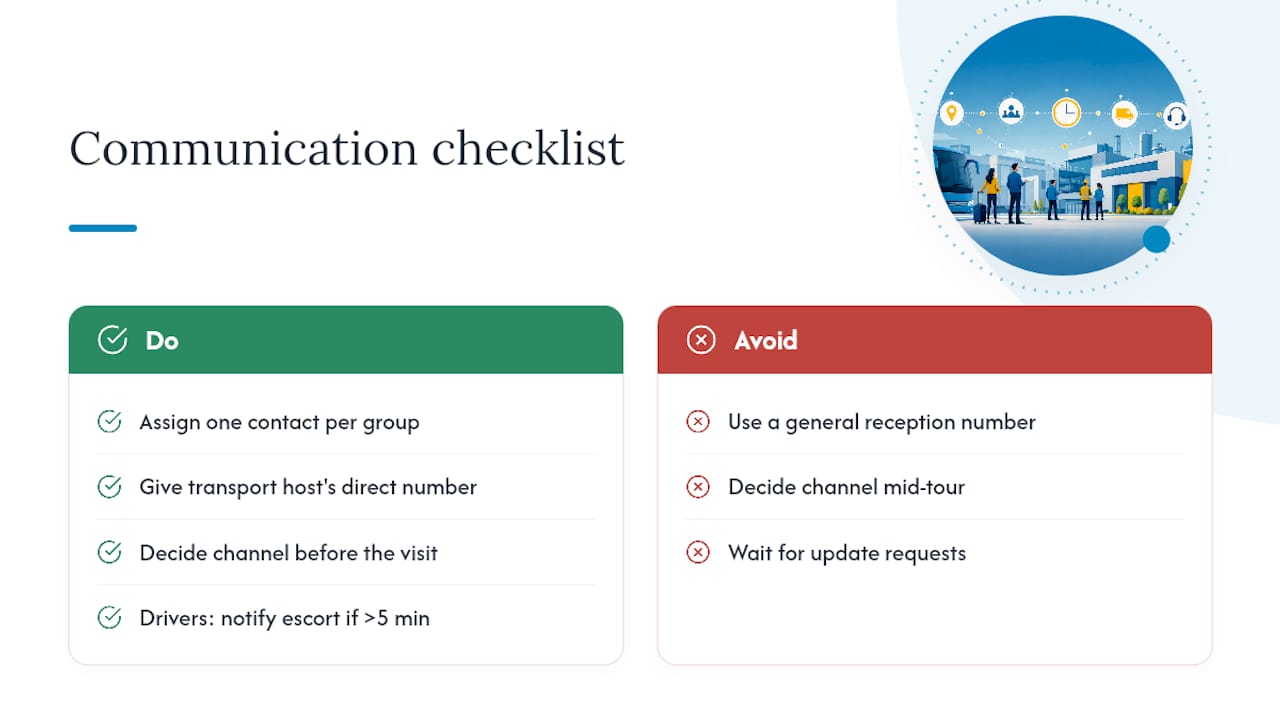
Set a single point of contact on each side before the day starts. The transport lead should have one direct number for the facility host, not a general reception line that routes through three people before reaching someone who can actually confirm a parking bay is clear. Visitors should have one name to ask for if they get separated from the group, printed on the manifest alongside their vehicle assignment.
Confirm the communication channel itself, not just the contact names. A WhatsApp group works for a domestic visit with a driver checking messages between legs; a facility with restricted phone use on the production floor needs a different method, perhaps a two-way radio handed to the escort at check-in. Decide this before the visit, because working it out mid-tour costs more time than the visit itself often allows.
Timing updates matter as much as the initial confirmation. If the facility host knows the group is running ten minutes behind, they can shift the next briefing slot rather than standing waiting. That single update, sent proactively rather than requested, is often what keeps a tight schedule from unravelling. Build it into the driver’s brief as a standing instruction: notify the escort the moment any leg runs more than five minutes off plan, and have the escort relay it on immediately.
What regulations apply to transporting visitors on industrial sites?
Industrial sites carry their own access and safety rules, and these sit alongside, not instead of, standard road transport regulations. A vehicle that is perfectly roadworthy for the public highway may still be barred from parts of a facility if it doesn’t meet the site’s own vehicle standards for emissions, noise, or size within restricted zones.
Confirm insurance coverage explicitly covers transport to and within industrial premises, including any liability exposure tied to visitor injury on-site. This is a conversation for your transport provider and the facility’s own risk team, not an assumption either side should carry alone.
Facilities that handle food production, pharmaceuticals, or hazardous materials often layer additional visitor requirements on top of general safety rules, from hygiene protocols to restricted zones that vehicles cannot approach at all. Ask the facility directly which regulatory framework governs visitor access, since this varies by sector and is rarely published anywhere public-facing.
None of this replaces the facility’s own compliance documentation. Treat the transport plan as the piece that gets people to the gate safely and on time; the facility remains the authority on what happens once visitors are inside it, and any conflict between your plan and their rules gets resolved in the facility’s favour, always.
What health and safety measures matter for transporting factory visitors?
Health and safety for factory visit transport starts before anyone boards a vehicle and continues until the last person is dropped off. PPE is the most visible piece, but it’s not the only one.
Vehicle idling near loading docks or production areas can breach a facility’s own air quality rules, so brief drivers explicitly on where they can and cannot leave an engine running. Emergency evacuation routes inside the facility rarely align with the vehicle drop-off point, which means the escort needs to know the nearest exit from wherever the group happens to be, not just the main entrance.
Visitors with mobility needs deserve the same safety caveat as any other passenger, applied consistently rather than as an afterthought. If PPE or a supervised walk is mandatory for general visitors, the same standard applies to anyone using a wheelchair or a walking aid. Confirm accessible vehicle options and step-free routes with the facility in advance, because retrofitting access on the day rarely works.

Finally, build a simple incident protocol into the driver and escort brief: who calls emergency services, who calls the facility’s own safety officer, and who keeps the rest of the group calm and clear of the affected area. A protocol nobody has to improvise in the moment is the one that actually gets followed.
Perspective: a compact planner checklist for transport leads
Five things to lock down before any factory visit: confirm the itinerary and flag the moments that cannot slip, reserve staging and vehicles against those exact times, brief drivers on site rules and contacts, book spare vehicle capacity for groups over twenty, and capture arrival and departure notes the same day. Everything else in a transport plan is detail. These five decide whether the visit runs on time or spends the afternoon apologising for itself.
— Gurdip
How Kler Transport can help you execute the plan
Once the itinerary is mapped and the staging point agreed, the practical question is who actually drives it. A provider that runs sedans, MPVs, minibuses, and coaches from a single fleet means the executive leg and the working-group leg of the same visit can be booked with one provider instead of coordinating two.
When you enquire, ask specifically for the vehicle mix that matches your itinerary, confirm whether the driver can be briefed on the facility’s site rules in advance, and check spare-vehicle availability if your group is over twenty. Kler Transport’s service pages cover the full fleet range including chauffeured minivan rental for working groups, and the rates page lists hourly booking from S$50 to S$100 per hour depending on vehicle type, alongside transfer pricing for point-to-point legs. If your visit spans a cross-border supplier stop in Malaysia, charter rates from that route are worth checking before you finalise a multi-site schedule. Request a customised quote through the Kler Transport site with your itinerary attached, and you’ll get a vehicle mix back rather than a generic quote.
Sources
- Freshening Experience Tour – Freshening Industries
- Tour to the HMGICS — NTUentrepreneur story
- Yakult factory tour information
- Plant visits, supplier audits and commissioning trips: The reality of manufacturing travel – FGT Corporate
FAQ
How far in advance should I book factory visit transport?
Lead times depend on the facility as much as the transport provider. Freshening Industries recommends a reasonable advance notice, while facilities with limited parking or high demand can need longer, so confirm both the tour slot and the vehicle booking together.
What is the minimum group size for a factory tour?
Minimum group sizes vary by facility. Freshening Industries requires at least eight visitors for its experience tour, and Yakult Singapore’s sessions typically expect groups in a moderate group size range, so check directly before assuming a smaller group qualifies.
What vehicle type suits a large factory delegation?
Coaches or minibuses suit the transfer to and from the site, but internal campus movement often needs smaller shuttles because of tight turning radii and dock access. Confirm vehicle suitability for the internal leg with the facility’s operations team rather than assuming one vehicle covers the whole visit.
Does Kler Transport offer vehicles for large factory visit groups?
Yes. Kler Transport’s fleet includes sedans, MPVs, minibuses, and coaches, which covers both executive transfers and larger delegation movements from a single booking. Rates and vehicle options are listed on the rates page.
What should a driver briefing cover before a factory visit?
A driver briefing should cover the confirmed route, parking and drop-off points, the on-site contact person, and emergency exit locations. It should also include privacy and security protocols, particularly around photography near production areas.