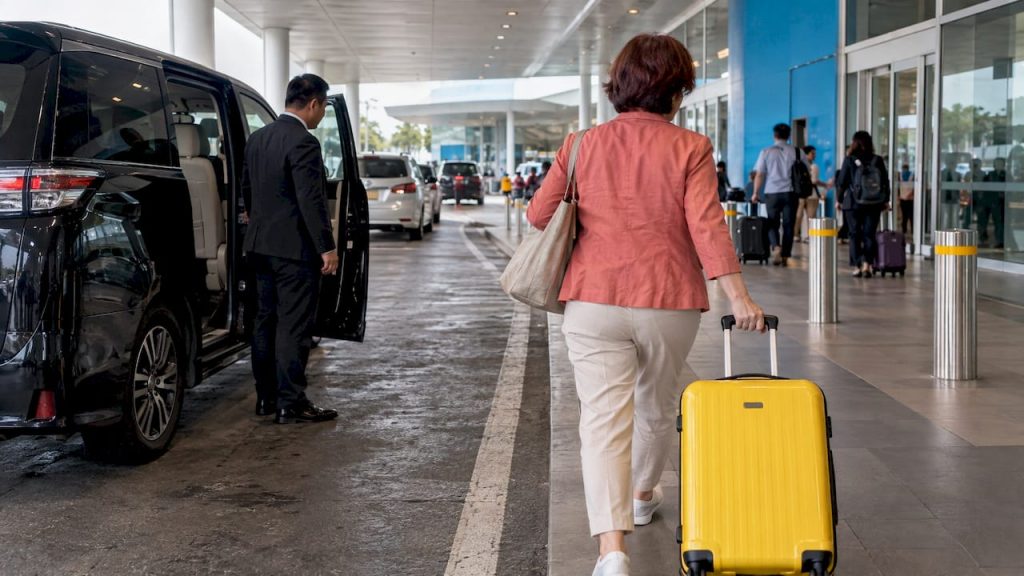
Luggage capacity is the number of bags a vehicle carries once every passenger is seated, and it is almost always lower than people expect. A saloon taxi typically takes two or three large suitcases, an MPV suits about four passengers with a sensible load of bags, and bigger groups need a van or minibus. The safest way to choose is to count your bags first and your seats second, then book the vehicle in advance.
This guide shows how to work out what fits for a Changi arrival or departure, why seat numbers on a brochure mislead, and how to book so nobody is left standing at the kerb with a suitcase on their lap.
TL;DR
- Seat count is not bag count. Fill every seat in an MPV or van and the boot space shrinks to very little.
- As a rule of thumb, a saloon suits one or two passengers with light bags, while an MPV suits about four passengers with a moderate amount of luggage.
- Count large suitcases, oversized items (golf bags, prams, instruments) and carry-ons separately, and tell the operator all three when you book.
- Taxis are exempt from Singapore’s child-seat rule, but a booked private-hire or chauffeured vehicle lets you request a child seat or a larger vehicle in advance.
- When in doubt, go one size up. At Kler Transport, airport arrivals are priced from S$65 and departures from S$60, depending on vehicle type and group size.
Table of Contents
- Why seats and suitcases are two different numbers
- How many bags fit in each vehicle type
- What the regulator says about boot space
- Step by step: estimate whether your group will fit
- Common situations and what to book
- Arrival or departure: where the luggage problem hits
- What to tell the operator when you book
- Price, vehicle size and midnight charges
- How we match vehicles to your bags
- Mistakes that cause luggage trouble
- FAQ
- Sources
Why seats and suitcases are two different numbers
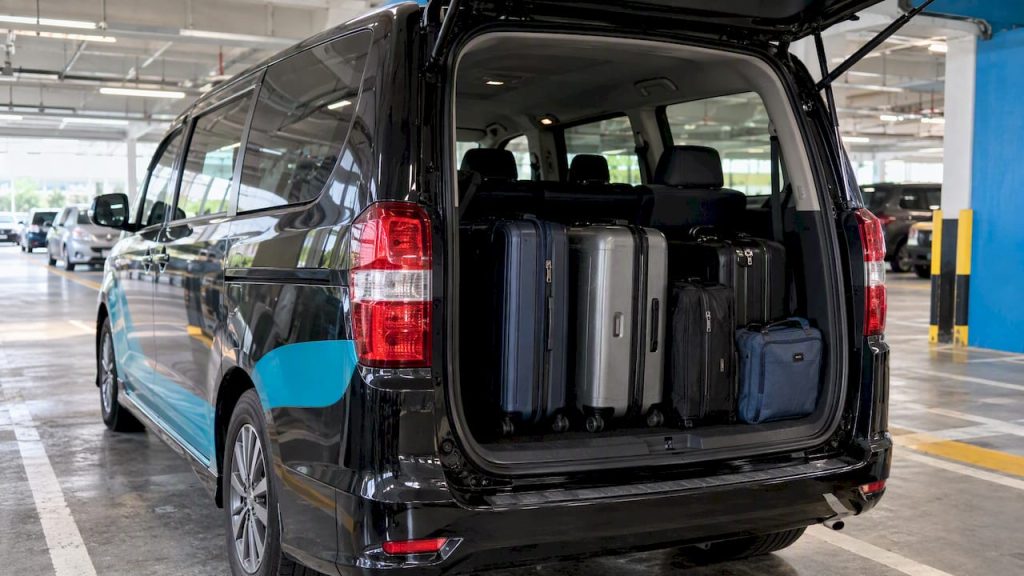
A vehicle listed as a seven-seater is describing people, not bags. In most MPVs and vans the boot sits behind the last row. When that row is occupied, the luggage area is a shallow well rather than a cargo bay. Fold the third row down and you gain space but lose seats.
That is why capacity is best thought of as a trade-off:
- More passengers, fewer bags. Every extra person in the rear rows takes boot space with them.
- More bags, fewer passengers. Folding seats or leaving them empty frees space for large cases.
- Soft bags behave better than hard shells. Duffels and backpacks can be squeezed into gaps. Rigid 28-inch cases cannot.
The pattern shows up in what travellers ask on Singapore travel forums: groups of eight or nine with six or more bags, or families of seven adults and four toddlers, are rarely asking about seats. They are asking whether everything and everyone fits in one vehicle. The honest answer is often that it depends on the exact bags, and it is cheaper to confirm that before the flight than at the arrivals hall.
Our own guidance on matching Singapore airport transfers to bags for groups starts from the same principle: match the vehicle to the luggage first.
How many bags fit in each vehicle type
The figures below are planning rules of thumb for typical Singapore airport transfers, not guarantees. Actual space depends on the specific vehicle, its configuration and the shape of your bags. Always confirm with the operator for your exact group.
| Vehicle type | Comfortable passenger count | Luggage expectation | Best for |
|---|---|---|---|
| Saloon car or standard taxi | 1 to 2 (up to 4 seated) | About 2 to 3 large suitcases at most, fewer with 3 or 4 passengers | Solo travellers, couples with light bags |
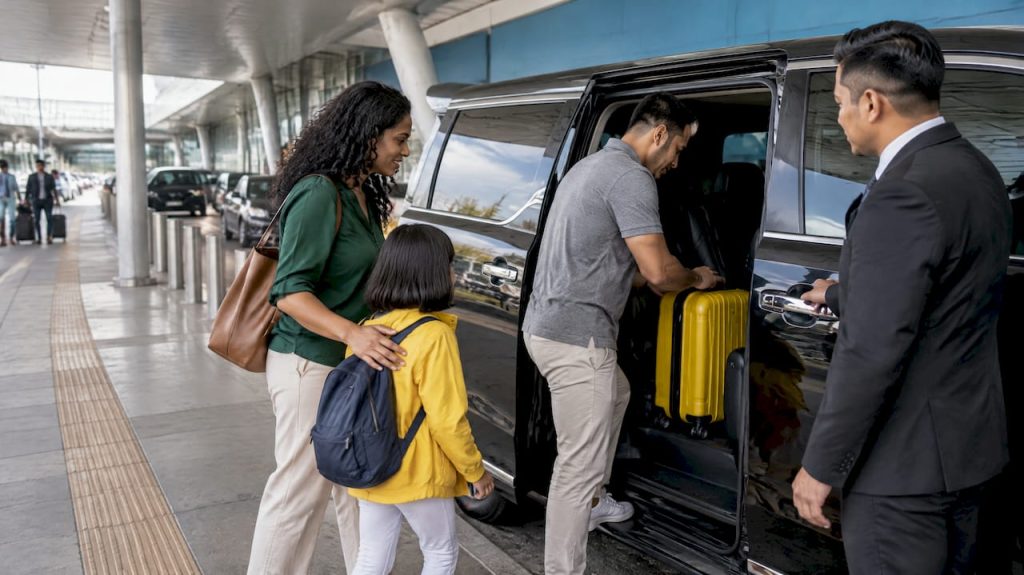
| 7-seater MPV | About 4 | Moderate luggage, roughly one large case per person | Families, small groups, business trips |
| 9 to 13-seater van | 6 to 9 | Proportional bags, less if every seat is used | Larger families, small teams |
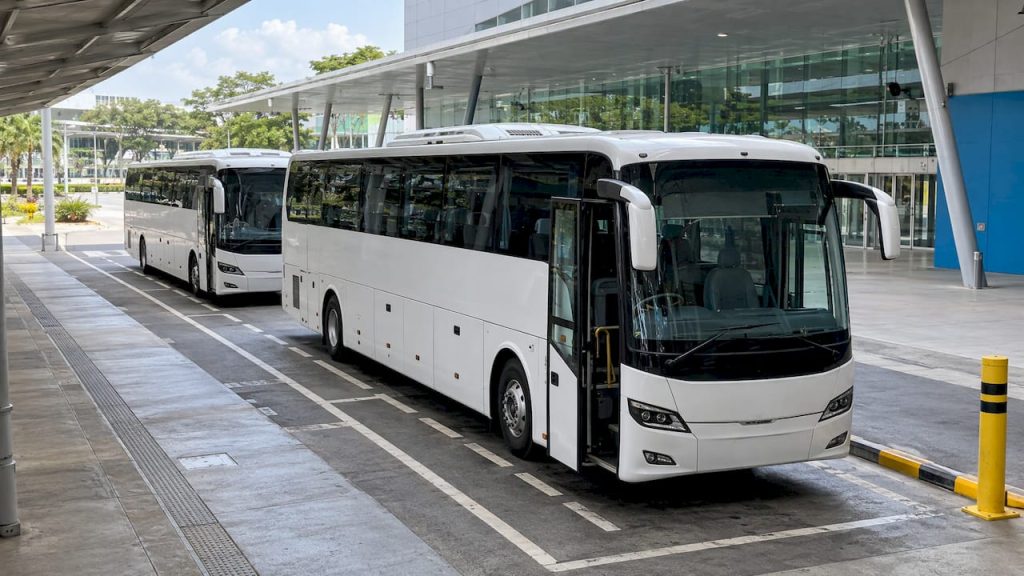
| Minibus | Larger groups | Dedicated luggage space varies by model | Tour groups, events, staff |
| Coach | Large groups | Hold space under the floor | Conferences, delegations |
The Land Transport Authority describes a typical saloon taxi as seating up to four adults, with premium taxi services accommodating more people or luggage. Four adults is a seat count. Four adults with four 24-inch suitcases in a saloon is a different problem, and usually one a boot cannot solve.
For a wider look at seat numbers across vehicle classes, see our guide to vehicle seating capacity in Singapore, from cars to coaches.
What the regulator says about boot space
Singapore’s regulator treats boot space as a real, finite resource. In its 2025 licensing announcement, the LTA noted that approved taxis must meet requirements including sufficient boot space to carry a folded wheelchair or luggage. That is a minimum standard for everyday use, not a promise that four people’s holiday luggage will fit.
The LTA also explained in December 2024 that fitting child-seat arrangements in every taxi could reduce the boot space needed for foldable wheelchairs, strollers or luggage. In other words, space in a standard vehicle is already a balance between competing needs. A family with a pram, a child seat and four cases is asking a lot of one boot.
Step by step: estimate whether your group will fit
You do not need measurements. You need an honest count and a margin.
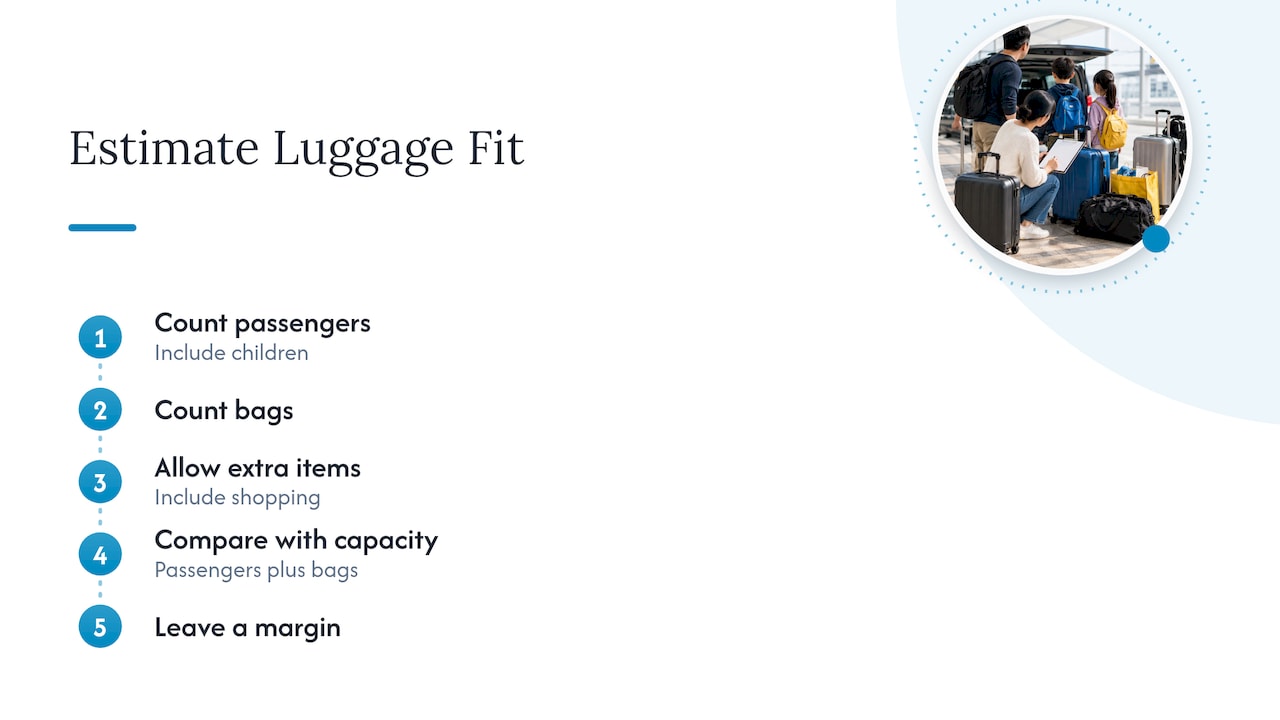
1. Count passengers, including children
Include infants and toddlers. A child on a lap still brings a pram, a bag or a car seat. If anyone needs a child restraint, note their age and weight.
2. Count bags in three groups
- Large check-in cases, typically 24 inches and above.
- Cabin bags and backpacks, which are small but still need floor or boot room.
- Awkward items: golf bags, surfboards, musical instruments, bicycles, folded prams, wheelchairs, sports equipment and boxes.
Write the numbers down. “A few bags” is not something an operator can plan around.
3. Add the shopping you have not bought yet
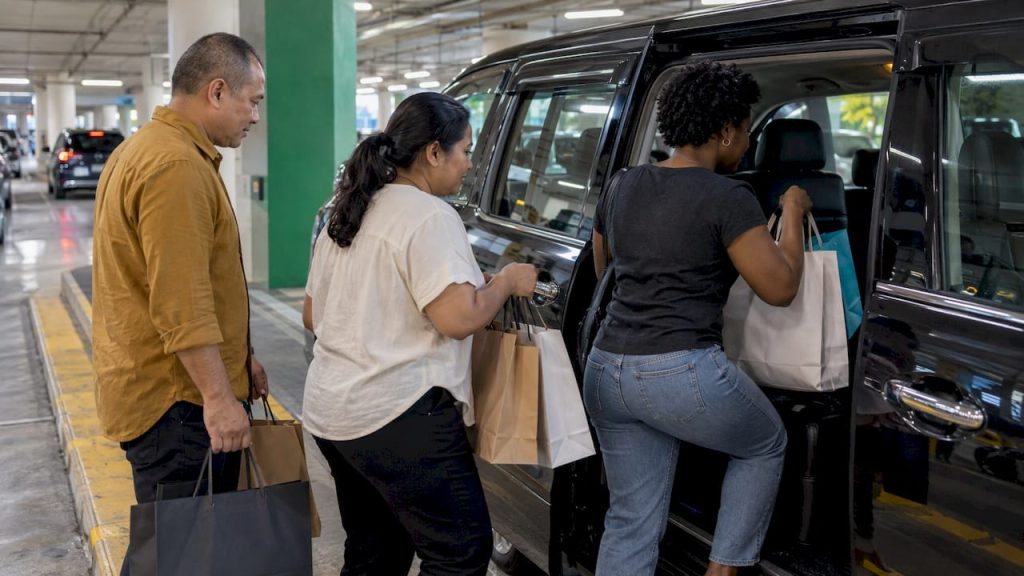
Departure groups tend to forget that souvenirs, duty-free and extra cases bought during the trip make the return leg heavier than the arrival. Arrival groups sometimes forget what they are collecting from the airport, such as boxes for a conference or gifts for relatives.
4. Check passengers plus bags against the vehicle
A simple test is to treat each large suitcase as roughly one seat of space in an MPV or van. A group of four with four large cases and a few backpacks is comfortable in a seven-seater. A group of six with six large cases is not, even though six passengers fit the seats on paper. That group needs a bigger van or a second vehicle.
5. Leave a margin
Tight packing means a slammed boot, a bag on someone’s feet and a fidgety, late start. If your count is borderline, go up one class. The extra fare is usually smaller than the cost of a second vehicle ordered in a hurry at the arrivals hall.
Common situations and what to book
Couples and solo travellers
One or two people with a cabin bag and one check-in case fit a saloon without trouble. If you are carrying two large cases each, you are near the limit of a typical boot and an MPV is more comfortable.
Families with prams and child seats
Families are where capacity goes wrong most often. A stroller, a child seat, a cabin bag per person and a couple of large cases is a lot of volume. According to the LTA’s December 2024 explanation, taxis are exempt from the child-seat rule, whereas booked private-hire cars let families request a child seat or a larger vehicle in advance. That is the main reason to pre-book rather than queue for a taxi when you have small children. Our guide for airport transfers for families covers the child-restraint side in more detail.
Seniors with mobility aids
Folding walkers and wheelchairs need boot space and quick loading. Mention them at booking, and allow extra time at the kerb. Our five-step guide to seniors’ airport transfers walks through the practical points.
Large groups, eight or more
A group of eight or nine with a full set of luggage rarely fits in one standard van. Operators that advertise capacity for nine passengers often mean nine passengers with limited bags, or fewer passengers with full luggage, not both. You have three sensible options:
- A larger van or minibus with a proper luggage area.
- Two vehicles, splitting passengers and bags evenly.
- A separate small vehicle just for luggage, if the group is large and the bags are many.
Our group airport transfer shortlist and booking guide explains how to compare these. For tour parties and delegations, the minibus charter guide and the coach charter guide cover vehicle fit and the checks that apply to larger vehicles.
Business travellers and event teams
Teams often arrive with laptops, display material, banners and boxes on top of personal luggage. Treat the event equipment as extra bags and say so. Our business transfers and event transfers pages explain how vehicles are arranged for these groups.
Staff and worker transport
When a company moves several people at once, such as incoming employees with their belongings, plan on a van or minibus and confirm the bag count per person. See staff and worker transport.
Arrival or departure: where the luggage problem hits
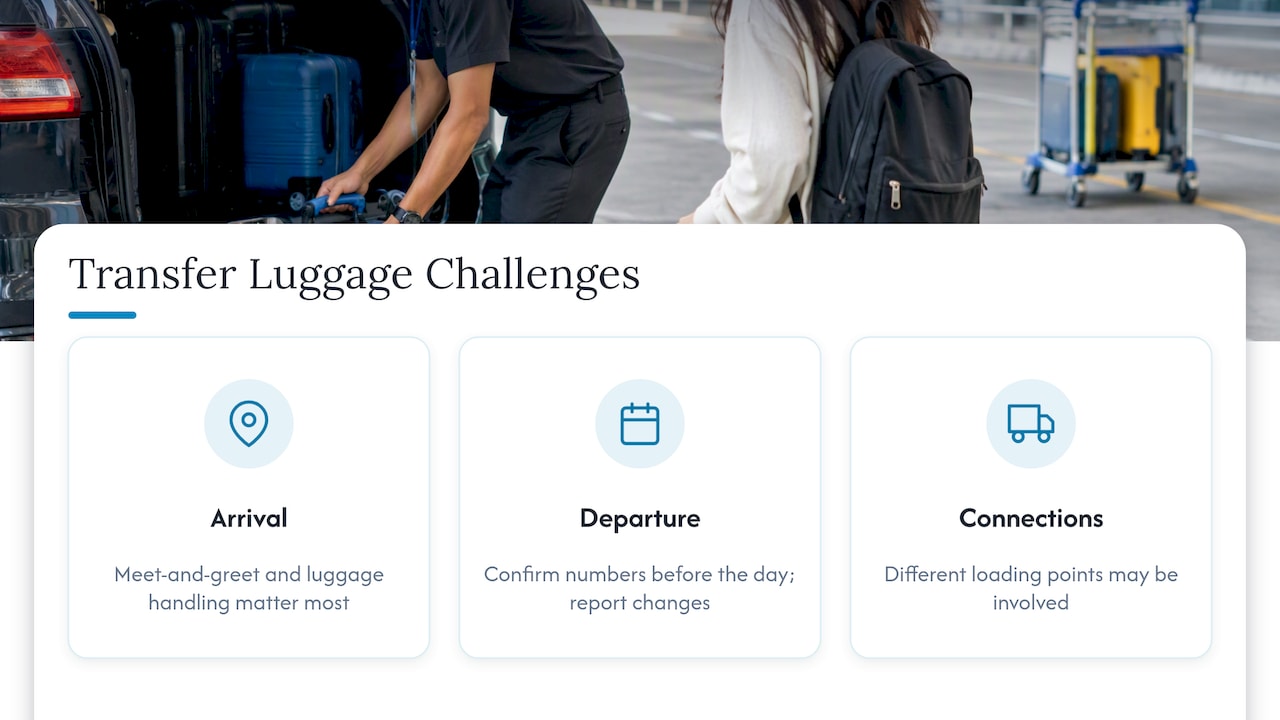
On arrival, you step out of the terminal with every bag you own, tired, in humid weather. A meet-and-greet and luggage handling by the driver matters most here. Your vehicle needs to be right the first time because there is rarely a quick fix at the pick-up point.
On departure, the problem is at your hotel or home. Everyone is packed, bags are stacked by the door and the driver is on a schedule. If the vehicle is too small, you find out at the worst moment. Confirm your numbers before the day, and send a message if anything changes, such as a case added at the last minute.
Between terminals or ferry terminals, if you are connecting to a cruise or a ferry, the transfer can involve different loading points. The ferry terminal transfers page covers Tanah Merah, HarbourFront and Changi.
What to tell the operator when you book
A good booking message is short and specific. Include:
- Number of adults, children and infants.
- Number of large suitcases, cabin bags and oversized items.
- Child seats or boosters needed, with ages.
- Mobility aids such as foldable wheelchairs or walkers.
- Flight number, terminal and arrival time, so the driver can track delays.
- Drop-off address, and any stops on the way.
The more precise the numbers, the less likely you are to be sent an undersized vehicle. “Six of us, six large cases, two backpacks, one pram” tells an operator more than “a family group”.
Price, vehicle size and midnight charges
Larger vehicles cost more, but so does a second car. At Kler Transport, published rates depend on vehicle type, group size and the service selected. Our rates page lists these ranges:
| Service | Published range |
|---|---|
| Airport arrival | S$65 to S$140 per trip |
| Airport departure | S$60 to S$130 per trip |
| Transfers | S$60 to S$130 per trip |
| Hourly booking | S$50 to S$100 per hour |
| Midnight charges | S$10 to S$20 |
The lower end of each range applies to smaller vehicles and the upper end to larger ones. Late-night flights are common at Changi, so allow for the midnight charge if your pick-up falls in that window. If you need a whole day with luggage stops, a charter at S$450 per day is listed on our charter rates page, which also covers Malaysia trips.
How we match vehicles to your bags
If you are planning a Singapore arrival or departure with more than a couple of cases, we would rather ask a few questions than send the wrong vehicle. Kler Transport provides chauffeured sedans, MPVs, minibuses and coaches, with meet-and-greet, luggage handling and experienced English-speaking drivers. Tell us your passengers and bags through the booking form, or read about our Changi airport transfers, available around the clock.
Mistakes that cause luggage trouble
- Booking by seat count alone. A seven-seater with seven people is a full car with no boot.
- Forgetting the pram or child seat. Both take real volume.
- Ordering a taxi for a group with many bags. A taxi is designed for ad hoc trips. Space for four adults does not mean space for four adults’ luggage.
- Mixing hard and soft cases without checking dimensions. Oversized cases are the main reason a boot will not close.
- Changing numbers late. Send an update if the group or bag count shifts, so the vehicle can be changed in time.
- Assuming one vehicle fits a large group. Two vehicles can be easier and often less stressful than one overloaded van.
FAQ
How many suitcases fit in a Singapore airport taxi?
A standard saloon taxi typically takes two to three large suitcases, fewer if four passengers are seated. The LTA says approved taxis need sufficient boot space for a folded wheelchair or luggage, which is a minimum, not a holiday-luggage guarantee. Larger loads need an MPV or van.
How many passengers can a taxi in Singapore take?
The LTA says a typical saloon taxi can seat up to four adults, while premium taxi services accommodate more people or luggage. Four passengers in a saloon leaves little boot space, so travel light or choose a larger vehicle.
Can seven people and their luggage fit in one MPV?
Usually not comfortably. A seven-seater MPV typically suits about four passengers with a moderate amount of luggage, because filling every seat leaves very little boot space. A group of seven with full luggage is better in a larger van, or split across two vehicles.
Do I need to book a child seat for an airport transfer?
Taxis are exempt from the child-seat rule, but the LTA notes that booked private-hire cars let families request a child seat or larger vehicle in advance. Give your child’s age and weight when you book, so the right restraint is ready.
What should I tell the operator about my luggage?
Give the number of large cases, cabin bags and oversized items, plus any pram, wheelchair or sports gear. Add passengers by age, your flight number and your drop-off address. Precise numbers let the operator assign the right vehicle the first time.
Sources
- LTA: Point-to-point services balance safety and practicality for families (18 December 2024)
- LTA: GrabCab Pte Ltd awarded street-hail service operator licence (2 April 2025)
- LTA: Taxi operators