
A corporate transfer invoice in Singapore should be a proper tax invoice when the supplier is GST-registered. It names both companies, describes each trip, shows the 9% GST as a separate line, and gives the total with and without GST. It also carries a payment due date. Get those items right and your finance team can claim input tax, approve the payment and file the document without chasing anyone.
This guide is for the people who book and pay for transfers: office managers, executive assistants, procurement teams and event organisers. It covers what to expect on the invoice, how extras like midnight charges are itemised, when the invoice should arrive, what InvoiceNow changes, and what to keep on file.
TL;DR
- A GST-registered supplier must issue a tax invoice showing its GST registration number, your company name and address, a description of each service, and the GST amount shown separately.
- GST is charged at 9% on local services. A tax invoice must be issued to a GST-registered customer within 30 days of the supply.
- Itemise every trip, hourly block and surcharge on its own line, so one booking reference matches one invoice line.
- InvoiceNow is being phased in for GST-registered businesses between 2025 and 2031, depending on the business’s category and turnover.
- Keep invoices, payment evidence and booking confirmations for at least 5 years.
Table of Contents
- What a corporate transfer invoice must contain
- When GST applies to corporate transfers
- How the lines should look: a worked example
- Itemising transfers, hourly hire and extra fees
- Payment terms and how to pay
- When the invoice should arrive
- InvoiceNow: what it means for transport invoices
- Records to keep
- A checklist before you book
- Booking corporate transfers with Kler Transport
- FAQ
- Sources
What a corporate transfer invoice must contain
For a GST-registered supplier, the rules are set out in Regulation 11 of the GST (General) Regulations 1993. IRAS summarises them on its invoicing page. A full tax invoice shows:
- the words “Tax Invoice” in a prominent place;
- a unique identifying number and the date of issue;
- the supplier’s name, address and GST registration number;
- your company’s name and address;
- a description sufficient to identify the services and the type of supply;
- for each description, the extent of the service and the amount payable excluding GST;
- any cash discount offered;
- the total payable excluding GST, the GST rate, and the GST amount as a separate figure;
- the total payable including GST.
If an amount is quoted in a foreign currency, the regulation also requires it to be expressed in Singapore dollars. Most local chauffeur bookings are in Singapore dollars, so this rarely applies. It matters if a foreign head office negotiated the rate in another currency.
Simplified tax invoices for small amounts
For supplies of S$1,000 or less including GST, IRAS permits a simplified tax invoice with fewer particulars. For anything above that, IRAS’s GST guide for businesses says required particulars cannot be left out. An invoice marked “Cash” instead of your company name and address is not acceptable, because a GST-registered customer needs a valid tax invoice to support its input tax claim.
In practice, one airport run is usually well under S$1,000. A month of daily staff runs, a multi-day charter or a conference shuttle programme can easily cross it. Ask for the full company name and address on the invoice from the start, so you never need a reissue later.
Details that are not in the regulation but that finance teams ask for
Beyond the legal minimum, corporate buyers usually want a few extra references on the invoice:
- your purchase order number or cost centre code;
- the booking reference and the passenger or department name;
- pick-up and drop-off points, with the date and time of each trip;
- the vehicle type used (sedan, MPV, minibus or coach);
- the supplier’s UEN and payment details.
These are practical conventions, not legal requirements. Tell the transport company which references you need at the time of booking, so they appear on the first invoice.
When GST applies to corporate transfers
GST is charged at the prevailing 9% on sales of goods and services made in Singapore by GST-registered businesses, except for exports, international services and exempt supplies. A chauffeured transfer between Changi Airport and a Singapore hotel or office is a local service, so GST applies if the supplier is registered.
Two points often cause confusion:
- Registration decides the invoice type. A supplier that is not GST-registered cannot charge GST or issue a tax invoice. If your finance team needs to claim input tax, confirm the supplier’s GST registration number before the first booking.
- Not every customer needs a tax invoice. IRAS states that a tax invoice does not need to be issued to a non-GST-registered customer. A GST-registered customer, such as most companies, is entitled to one.
For cross-border legs, such as a transfer from Singapore to Johor or Malacca, the tax treatment depends on the nature of the service. Treat it as a separate question for your finance team or tax adviser rather than assuming the domestic rule applies. Our Malaysia charter rates list a charter vehicle at S$450 per day, and the invoice for such a booking should show that day charge on its own line.
How the lines should look: a worked example
A good invoice lets someone who was not on the trip match each charge to a booking. The example below is illustrative only. The amounts are made up to show the layout and are not our prices.
| Line | Description | Amount excl. GST |
|---|---|---|
| 1 | Airport arrival, Changi T3 to hotel, 12 March, flight SQ000 | S$100.00 |
| 2 | Midnight surcharge, same trip | S$15.00 |
| 3 | Hourly booking, 4 hours, 13 March, MPV | S$280.00 |
| Total excluding GST | S$395.00 | |
| GST at 9% | S$35.55 | |
| Total including GST | S$430.55 |
Three things make this layout easy to approve:
- The surcharge sits on its own line rather than being folded into the trip price.
- The hourly block states the number of hours, so the maths can be checked.
- GST is a separate figure, calculated on the full excluding-GST total.
Itemising transfers, hourly hire and extra fees
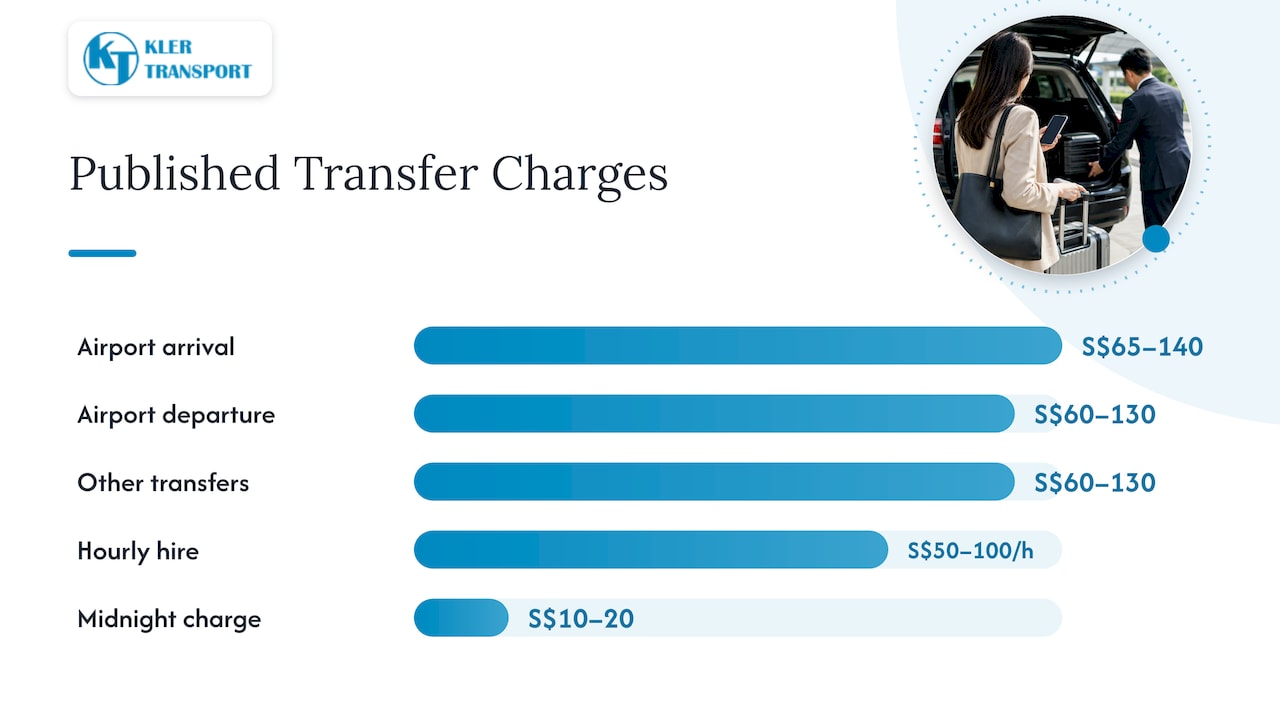
Our published rates show how a transport price is built from separate components. As listed on our rates page, airport arrival runs from S$65 to S$140, airport departure from S$60 to S$130, and other transfers from S$60 to S$130, all one-off. Hourly bookings run from S$50 to S$100 per hour. The range depends on the vehicle type, the group size and the service chosen. Midnight charges are listed at S$10 to S$20.
When you receive an invoice, check these items:
One-off transfers
Each trip should be a separate line with the date, the route and the vehicle class. If a driver collected three colleagues from the same flight, that is one trip, not three. Matching the passenger count to the vehicle on the quote avoids disputes.
Hourly charters
The invoice should state the hours booked and the hourly rate. Agree in advance how the clock starts and stops, and how any overrun is treated. Our guide to private transfer payment explains what to expect on pricing and payment for private transfers.
Surcharges
Midnight charges and any other add-ons should be named, not hidden in a rounded trip price. This also helps when an executive asks why a late-night arrival cost more than a daytime one.
Discounts
If a cash discount is offered, Regulation 11 requires it to appear on a tax invoice. Do not accept a negotiated discount that exists only in an email thread.
Payment terms and how to pay
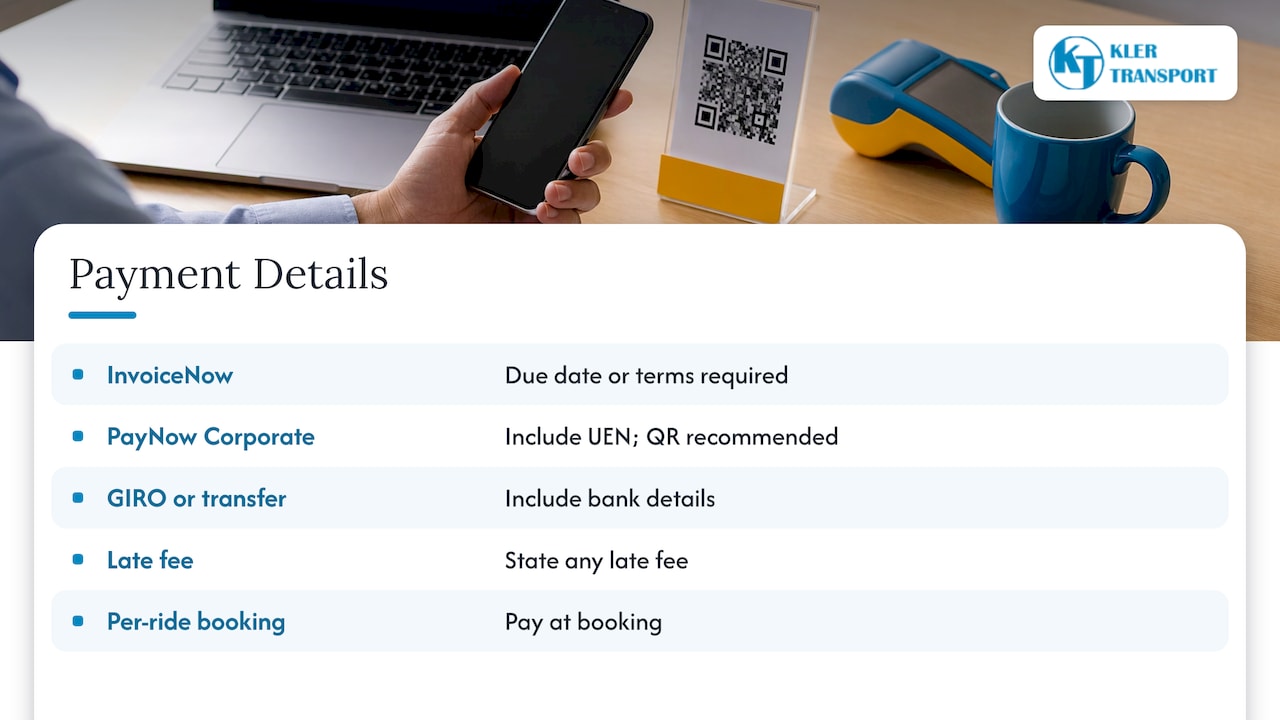
For invoice data sent through InvoiceNow, IMDA’s technical specifications say that where the amount due is positive, either the payment due date in YYYY-MM-DD format or the payment terms must be present. The IMDA data specifications set this out. Even on a plain PDF invoice, a clear due date prevents the most common cause of late payment: nobody knowing when the invoice was due.
A practical invoice also tells you how to pay. InvoiceSG’s Singapore template guide suggests including the business UEN for PayNow Corporate, ideally with a PayNow QR code, and bank account details for customers who pay by GIRO or telegraphic transfer. It also recommends stating any late fee. Agree the method and the terms with the transport company before the first booking, and write them on your purchase order.
For one-off tourist or family bookings paid per ride, you may simply pay at the time of booking. A corporate buyer should still ask for a tax invoice and not rely on a payment receipt alone.
When the invoice should arrive
IRAS states that a tax invoice must be issued to a GST-registered customer within 30 days from the time of supply. Finance teams should therefore expect the invoice no later than 30 days after the trip. If you run month-end accruals, tell the supplier your cut-off date, so trips taken near the end of the month are invoiced in time.
A useful routine for an office manager:
- Keep a simple log of each trip: date, passenger, booking reference, purchase order.
- When the invoice arrives, check it line by line against the log.
- Query any mismatch the same day, while the driver’s notes and the booking record are fresh.
- Pass the approved invoice to finance with the purchase order attached.
InvoiceNow: what it means for transport invoices
InvoiceNow is Singapore’s nationwide e-invoicing network, built on Peppol. Per IRAS’s FAQs for businesses on the GST InvoiceNow requirement, GST-registered businesses must use InvoiceNow-Ready Solutions to transmit invoice data to IRAS in phases:
| Start date | Who is covered |
|---|---|
| 1 November 2025 | Newly incorporated companies applying for voluntary GST registration |
| 1 April 2026 | All new voluntary GST registrants |
| 1 April 2028 | New compulsory registrants, and existing businesses with annual supplies of S$200,000 or less |
| 1 April 2029 | Existing businesses with supplies above S$200,000 and up to S$1,000,000 |
| 1 April 2030 | Existing businesses with supplies above S$1,000,000 and up to S$4,000,000 |
| 1 April 2031 | Existing businesses with supplies above S$4,000,000 |
The requirement is one of the responsibilities of a GST-registered business, listed on IRAS’s page on GST-registered businesses’ responsibilities alongside charging GST correctly, filing returns, keeping records and issuing proper tax invoices.
What does this mean if you are the buyer? Three things:
- You do not need to change how you book. The requirement sits with the GST-registered supplier’s invoicing system.
- The content stays the same. IMDA’s InvoiceNow FAQs confirm that an InvoiceNow e-invoice meets tax invoice requirements, provided it contains everything Regulation 11 requires.
- If your accounting system is InvoiceNow-enabled, you may be able to receive supplier invoices directly into it, which cuts re-keying. Ask your finance team whether that is set up before you ask suppliers to change anything.
Because the phase dates depend on a business’s registration status and turnover, a supplier may not yet be on InvoiceNow. That is normal and does not affect the validity of a correct PDF tax invoice.
Records to keep
GST-registered businesses must keep business and accounting records for at least 5 years. IRAS’s record-keeping guide lists sales invoices, tax invoices, simplified tax invoices, serially numbered receipts, credit notes, evidence of payments received, and customer contracts or agreements. The same guide says the obligation applies whatever the payment channel, including PayNow.
On the buyer’s side, a sensible file for each transport expense holds:
- the quote or rate confirmation;
- the booking confirmation with the booking reference;
- the tax invoice;
- your purchase order and approval;
- proof of payment.
The five-year period also applies to e-invoices. Whether you receive PDFs or InvoiceNow data, store them in a way that keeps them complete and unaltered, so they can support your GST claims if IRAS asks.
A checklist before you book
Use this list when you set up a corporate transfer arrangement:
- Confirm the supplier’s GST registration status and number.
- Give them your exact company name, address and billing contact.
- State whether you need a purchase order number on each invoice.
- Agree how trips will be grouped: per trip, per week or per month.
- Ask how surcharges such as midnight charges and hourly overruns will be shown.
- Agree payment terms and the payment method (PayNow Corporate, GIRO or bank transfer).
- Agree who receives the invoice and by what channel.
- Set a monthly cut-off for trips taken near month-end.
The same discipline helps on larger programmes. If you are planning an event, our conference shuttle planning guide covers the operational side, and the company offsite transport checklist covers what organisers should confirm. Procurement teams issuing tenders can use our roadshow transport RFP as a template. For regular staff runs, see employee commute options for employers.
Booking corporate transfers with Kler Transport
We provide chauffeured private transport across Singapore: airport transfers, hourly charters, event and attraction transfers, ferry terminal runs, staff transport and cross-border transfers to Johor and Malacca. Our fleet covers sedans, MPVs, minibuses and coaches, with meet-and-greet, luggage handling and English-speaking drivers. Rates are per trip, per hour or per charter, based on vehicle type, group size and service.
If you are arranging transport for your company, see our business and corporate transport page or check the published rates. When you make a booking, tell us the company details and references you need so your finance team gets what it requires.
FAQ
Does a corporate transfer invoice need to show GST?
If the supplier is GST-registered, yes. The invoice must show the GST rate, the GST amount as a separate figure, and the totals with and without GST. A supplier that is not registered cannot charge GST or issue a tax invoice.
How soon should I receive the invoice?
IRAS says a tax invoice must be issued to a GST-registered customer within 30 days from the time of supply. If you need it sooner for month-end accounts, agree a cut-off date with the supplier when you book.
Can I claim GST on a simplified tax invoice?
A simplified tax invoice is permitted for supplies of S$1,000 or less including GST. For larger amounts, IRAS expects the full particulars, including the customer’s name and address. Ask for the full tax invoice if your finance team will claim input tax.
How long should we keep transfer invoices?
GST-registered businesses must keep accounting records, including tax invoices and evidence of payment, for at least 5 years. Keep the booking confirmation and purchase order with each invoice so the file stands on its own.
Do I need InvoiceNow to receive a transport invoice?
No. The InvoiceNow requirement applies to GST-registered suppliers on a phased timetable, and a correct PDF tax invoice remains valid. If your accounting system supports InvoiceNow, ask your finance team whether you can receive invoices that way.
Sources
- IRAS: Invoicing Customers
- Singapore Statutes: GST (General) Regulations 1993, Regulation 11
- IRAS e-Tax Guide: GST General Guide for Businesses
- IRAS: When to Charge GST
- IRAS: FAQs for Businesses on the GST InvoiceNow Requirement
- IRAS: Responsibilities of GST-registered businesses
- IMDA: InvoiceNow FAQs
- IMDA: InvoiceNow data specifications
- IRAS: Record Keeping Guide for GST-registered Businesses
- InvoiceSG: Invoice template for Singapore