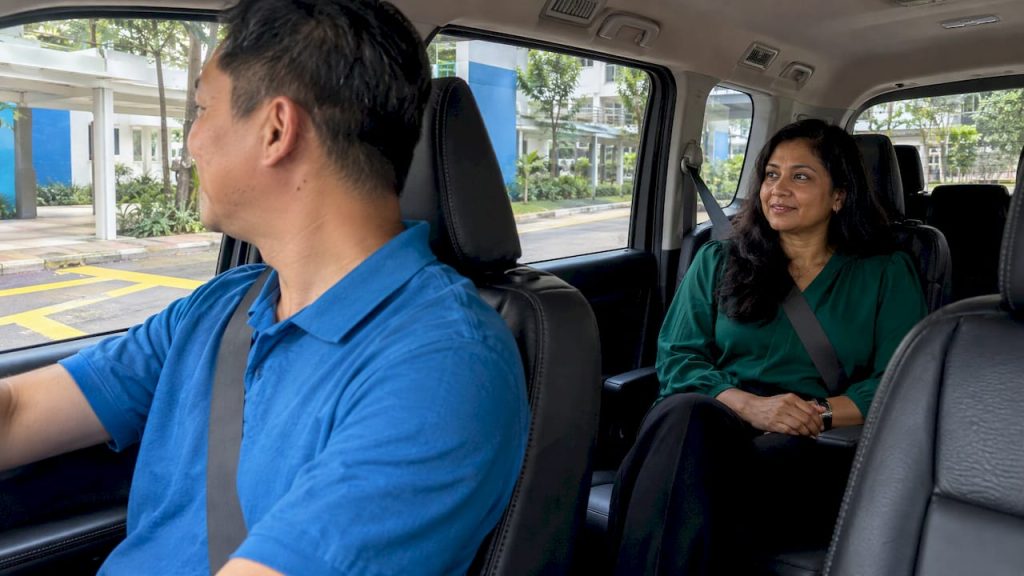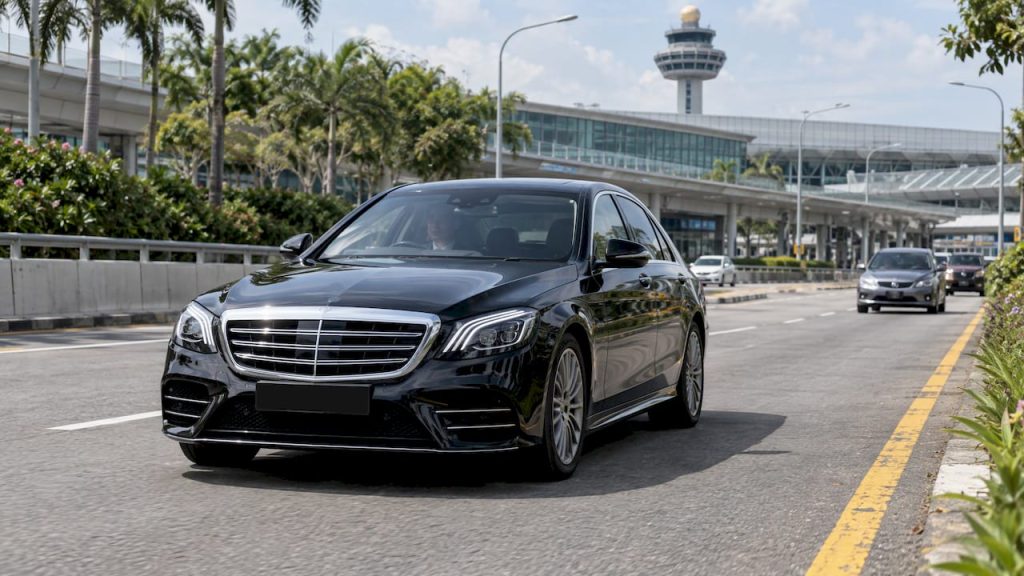
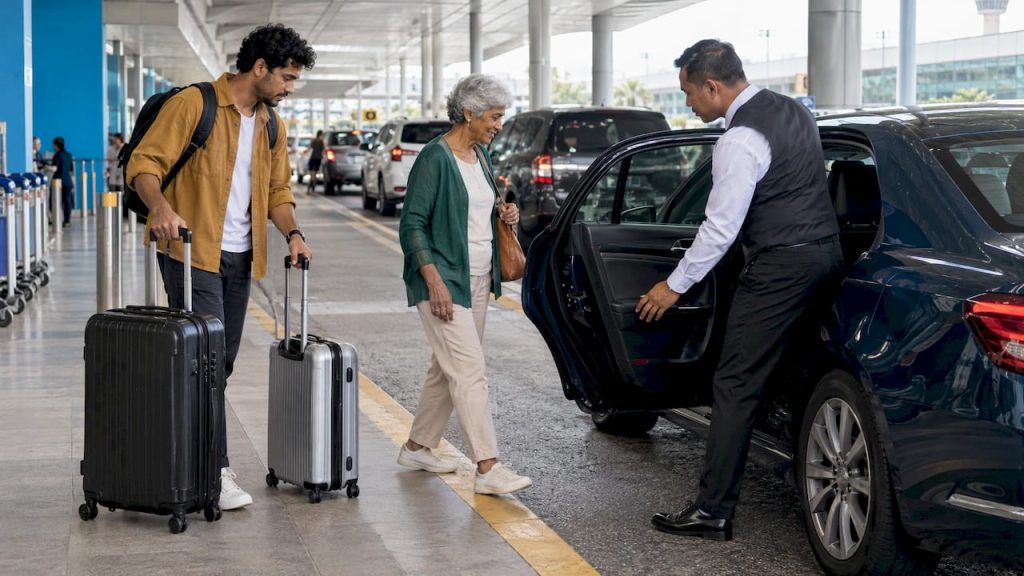
If you are coming to Singapore for a medical appointment, or accompanying someone who is, the right transport depends on one question: does the patient need clinical care on the way? If not, a private chauffeured car from Changi Airport to your hotel and on to the hospital is the simplest door-to-door option. If yes, you need a licensed medical transport or ambulance service, not a regular car. This guide explains how to tell the difference and how to plan each leg of the trip.
TL;DR
- Patients who can sit upright and walk or transfer with help can use taxis, private-hire cars or a pre-booked chauffeured transfer. Patients who need monitoring or medical care in transit need a licensed Medical Transport Service (MTS).
- For life-threatening emergencies, call 995. Do not arrange a private car.
- Some hospitals run free shuttles from nearby MRT stations, but not from the airport. Check your hospital’s visitor page before you fly.
- Pre-booking a meet-and-greet airport pickup removes the stress of arriving tired, with luggage, in an unfamiliar city.
- Only use licensed providers for ambulance-type services, and ask for charges before you travel.
Table of Contents
- Who counts as a medical visitor, and what transport do they need?
- When ordinary transport is not enough
- Planning the journey from Changi Airport to the hospital
- Getting around hospital campuses
- Choosing transport when mobility is limited
- Families, corporate travellers and larger groups
- Rules and safety: what to check before you book
- What it costs
- Book a calm, on-time transfer with Kler Transport
- FAQ
- Sources
Who counts as a medical visitor, and what transport do they need?
A medical visitor is anyone travelling to Singapore for a consultation, treatment, a scan, a procedure or follow-up care, plus the family members or colleagues who travel with them. Their needs vary a great deal. A business executive in for a health screening needs punctuality. A family accompanying a child to a specialist needs space for luggage, pushchairs and extra adults. A frail grandparent needs a low-step vehicle and a patient driver. A post-surgery patient may need to lie down or be monitored.
Singapore’s transport network can handle most of these. LTA describes an integrated system of trains, buses, taxis and private-hire cars, with taxis and private-hire cars offering all-hours, door-to-door convenience. That door-to-door element matters most when you are unwell, jet-lagged or carrying medical files.
It helps to think in three tiers:
- Public transport: MRT and buses, best for mobile, well patients and companions.
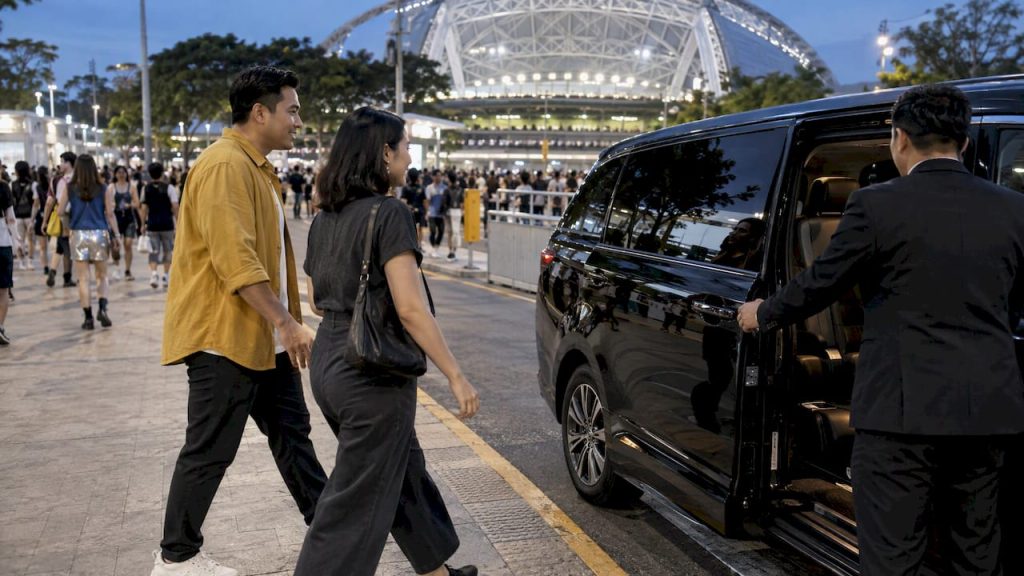
- Private chauffeured transport: sedans, MPVs and minibuses for patients who can sit in a normal seat and need comfort, timing certainty and help with bags.
- Licensed medical transport: for patients who need a stretcher, clinical monitoring or medical staff on board.
Much of the confusion in this area comes from mixing up tiers two and three, so the next section deals with that first.
When ordinary transport is not enough
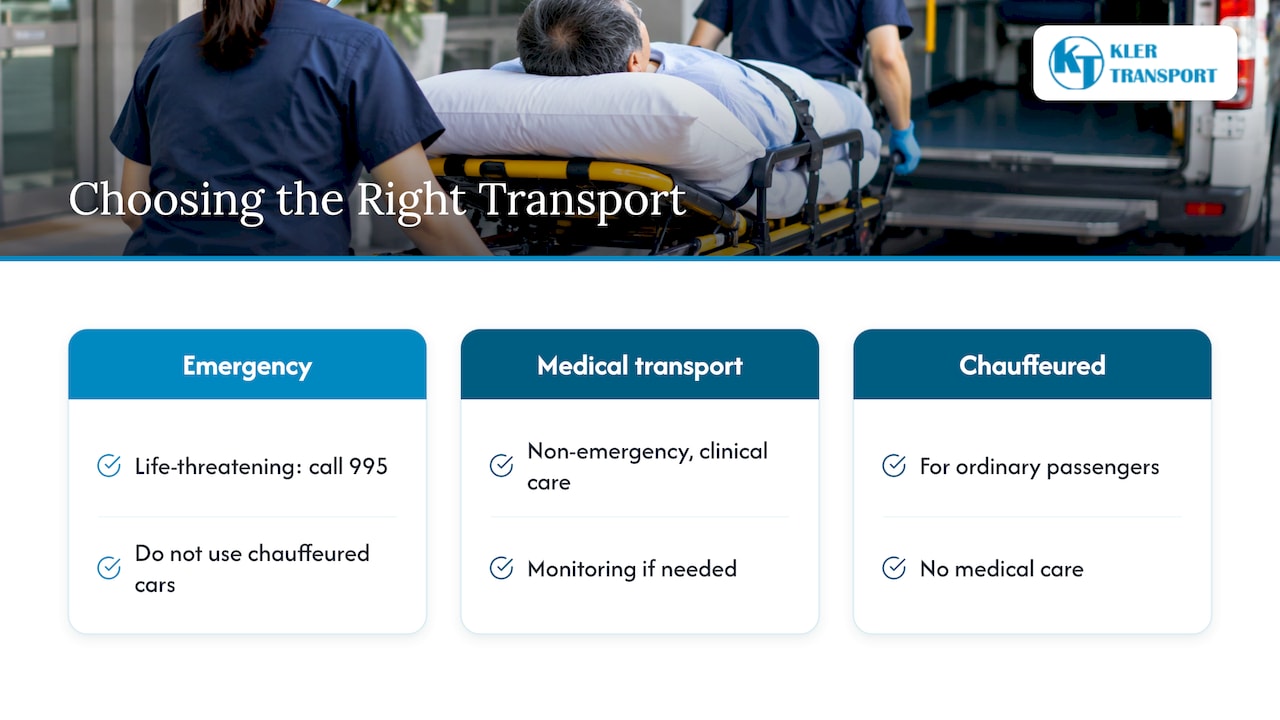
For life-threatening emergencies such as cardiac arrest, seizures, breathlessness, loss of consciousness, excessive bleeding, major trauma and stroke, MOH says to call 995. A chauffeured car, taxi or private-hire vehicle is not the right response to any of these.
For patients who are not emergencies but still need care on the way, Singapore has Medical Transport Services. According to the same MOH page, an MTS conveys patients who are not emergency cases, with clinical care and monitoring if necessary. Examples would be a patient who must travel lying down or one who needs oxygen or observation en route. If your specialist or hospital coordinator says the patient needs this level of care, ask them to recommend a licensed provider.
A chauffeured transfer from a company like ours is designed for passengers who can travel as ordinary passengers. We are a private transport company, not an ambulance or medical transport operator, and our drivers are there to drive, assist with luggage and make the journey smooth. If you are unsure which category applies, ask the treating doctor before booking anything.
Planning the journey from Changi Airport to the hospital
Most medical visitors face the same three legs: airport to accommodation (or straight to the hospital), accommodation to appointments, and back to the airport. Each has its own pitfalls.
Airport to hotel or hospital
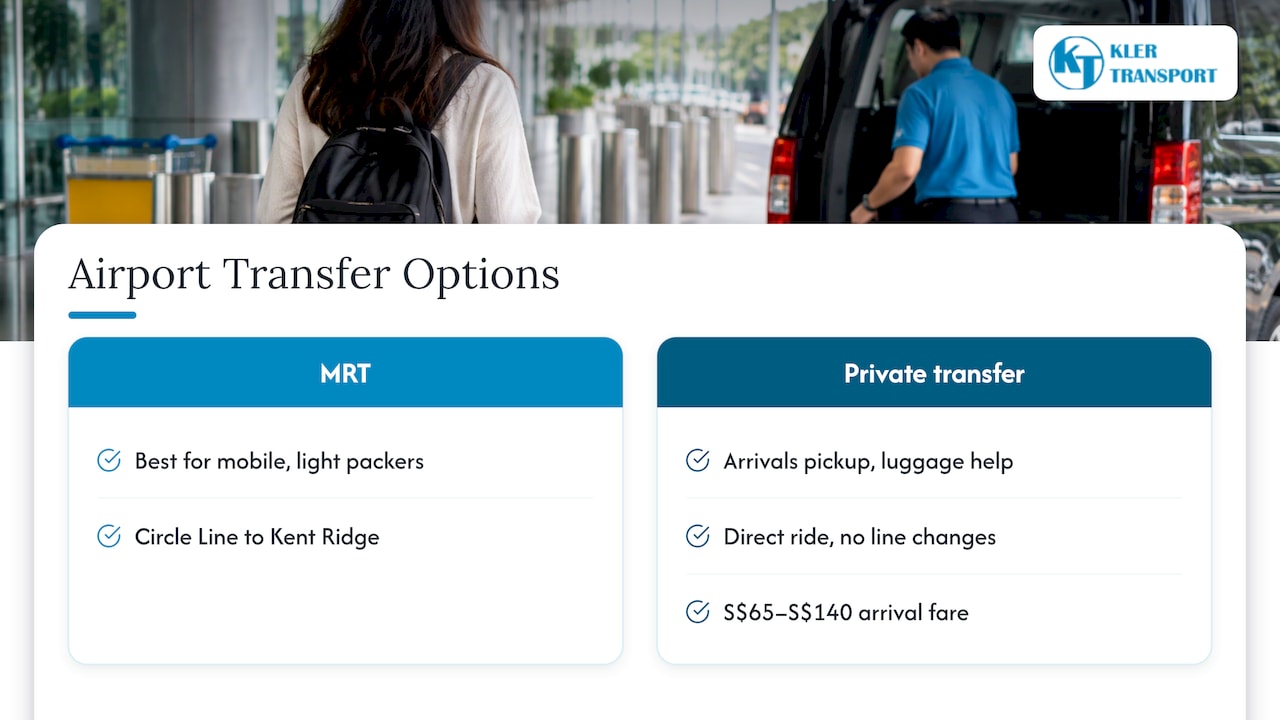
Do not assume your hospital will collect you. National University Hospital states that airport transfer services are not available and suggests taxis, private-hire vehicles or the MRT via the Circle Line to Kent Ridge, which is next to the hospital. That is a useful reminder that each hospital’s international patient guide is the first thing to read.
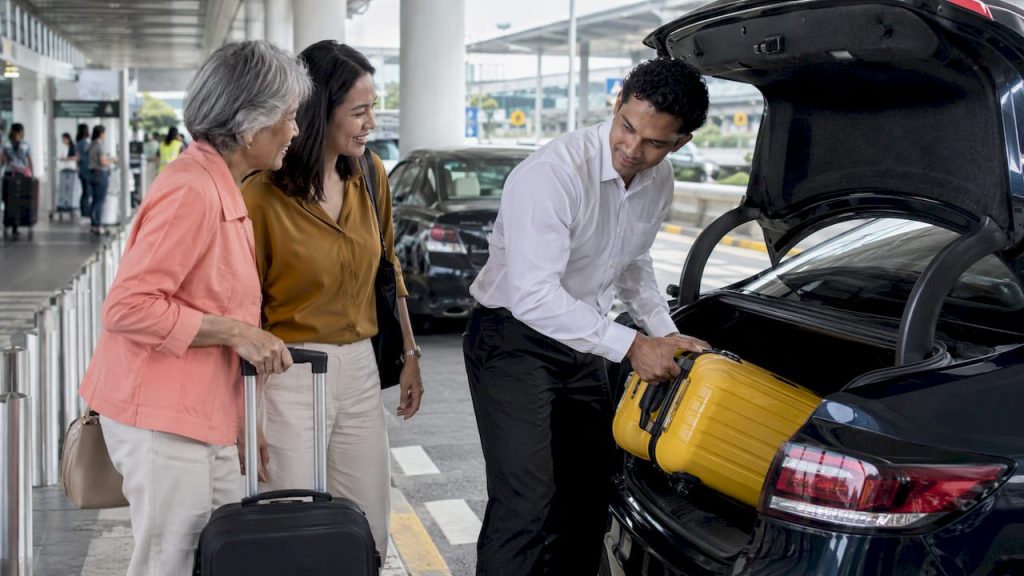
The MRT works for a light-packing, mobile traveller. For anyone tired, in pain, travelling with a wheelchair-folding companion, or arriving with several suitcases and medical documents, a pre-booked private transfer is easier. Your driver waits at arrivals, helps with luggage and drives you directly to your destination, with no queue and no transfer between lines.
Our airport transfer service from Changi runs around the clock, which suits the red-eye arrivals many long-haul medical travellers have. Our published airport arrival rates run from S$65 to S$140 depending on vehicle type, and a midnight charge of S$10 to S$20 applies for late-night trips. See the current rates page for the vehicle that fits your group. For a comparison of what airport transfers cost across different modes, our guide to airport transfer costs in Singapore explains how surge pricing affects the choice.
If the patient is a senior, our five-step guide to seniors’ airport transfers covers boarding, timing and what to tell the driver in advance.
Hotel to appointments
The pattern here is repeat short trips, often at early hours for fasting blood tests, scans or day surgery. Two options work well:
- Point-to-point transfers, booked per trip. Our transfers are published at S$60 to S$130 per trip, depending on vehicle and distance.
- Hourly booking, useful when you have a consultation, a pharmacy stop and a return to the hotel, and do not want to rebook a car each time. Our hourly rate is S$50 to S$100 per hour, depending on the vehicle.
Hourly booking is often the calmer choice on a day of multiple appointments, because the car and driver wait while you are in the consultation room. Tell us the hospital, the appointment time and the likely duration so we can plan the day around it.
Back to the airport
Build in extra time after any procedure. Ask your doctor whether you are fit to fly and when, and book the airport departure after that is confirmed. Our airport departure rates are S$60 to S$130. Choose a vehicle with enough room to recline slightly or stretch legs if you are recovering, and tell the booking team about any mobility needs when you reserve.
Getting around hospital campuses
Singapore’s big hospitals are large, and arriving at the right entrance saves a lot of walking. Several offer free shuttles, but they usually connect to MRT stations rather than the airport.
| Hospital | What the hospital says about getting there |
|---|---|
| Singapore General Hospital | Sits at Outram Park MRT, which connects three lines. Two campus shuttle bus services (Blue and Orange) link institutions and MRT stations. A free wheelchair shuttle runs to and from Outram Park MRT for wheelchair-bound patients. |
| SGH taxi stands | Eight designated taxi stands around the campus, including at the National Cancer Centre, Singapore National Eye Centre, National Heart Centre and National Dental Centre. |
| Changi General Hospital | Free weekday shuttle from Simei MRT, excluding public holidays. Buses to the Main Building and Medical Centre run every 15 minutes, to the Integrated Building every 20 minutes. |
| Tan Tock Seng Hospital | Reached via Novena MRT (Exit A), with a full-day shuttle bus within the HealthCity Novena campus. |
| Thomson Medical Centre | Complimentary shuttle between the hospital and Novena MRT, Mondays to Saturdays roughly every 30 minutes, none on Sundays and public holidays. |
These shuttles are helpful, but they have fixed schedules and fixed stops, and some do not run on Sundays or public holidays. If your appointment falls outside those hours, or the patient tires easily, a private car straight to the correct entrance is more predictable. Always confirm the exact entrance and drop-off point with the clinic when you receive your appointment letter, and give it to your driver in advance.
Choosing transport when mobility is limited
Singapore is well set up for accessible public transport. LTA reports that all public buses and trains are wheelchair accessible, with barrier-free routes in all train stations and bus interchanges, and that 98% of bus stops are barrier-free. That is good news for a wheelchair user who is otherwise independent.
For patients recovering from a procedure, the question is different: how much walking, waiting and stepping is involved? Consider these factors:
- Distance from the kerb to the consultation room. Ask the hospital for the best drop-off point.
- Vehicle height and door width. A sedan is low and quick to board for some people; an MPV has a higher step but wider door opening and more space for a companion and a folded walker. Tell us what the patient uses and we will suggest the best fit from our fleet.
- Luggage and equipment. Folded walkers, medical bags and files need boot space.
- Timing. Avoid squeezing a transfer into a tight connection after a long flight.
If the patient needs to travel in a wheelchair without transferring to a seat, look for a provider with a wheelchair-accessible vehicle. The Agency for Integrated Care and SG Enable’s safe transport guidelines for wheelchair-accessible vehicles recommend four-point strap systems to secure wheelchairs to the vehicle floor, three-point seatbelts where feasible, and trained personnel who can operate a hydraulic lift. Those are sensible questions to put to any operator offering wheelchair transport.
For the general landscape of non-emergency options elsewhere, a guide to private medical transportation shows the kind of services that exist, from wheelchair and stretcher rides to help through admissions and recurring appointment trips.
Residents may also know the AIC’s Medical Escort and Transport service, which provides wheelchair-accessible vehicles and an escort to medical appointments, with round trips starting from $40 before subsidies. Subsidies are means-tested for Singapore Citizens or PRs, so this is generally a resident scheme rather than something a visiting patient can rely on. Our article on medical appointment transport in Singapore sets out how MET subsidies and private rides compare for residents.
Families, corporate travellers and larger groups
Medical trips rarely involve one person. A parent, spouse, adult child, interpreter or colleague often travels too, and everyone’s bags arrive on the same flight.
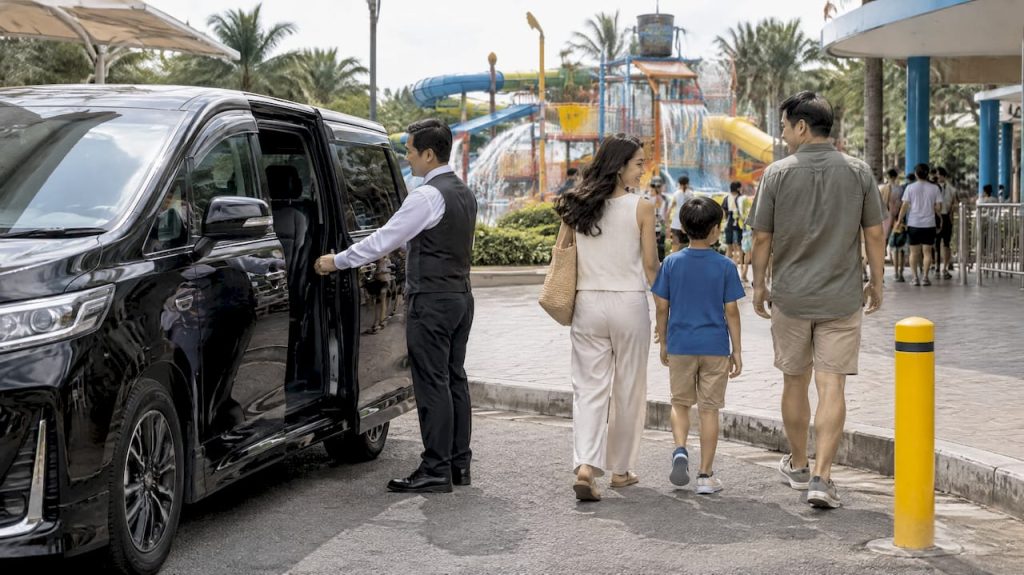
Families. Count passengers and bags before choosing a vehicle. A family of four with two large suitcases and a folded pushchair fits better in an MPV than in a sedan. If grandparents are travelling with you, tell the booking team so the driver can allow extra time at the kerb. Our fleet includes sedans, MPVs and minibuses, so you pay for the space you need.
Corporate travellers. Executives combining a health assessment with meetings value punctuality and discretion. Our business and corporate transport service handles point-to-point trips and hourly bookings, so one driver can take you from hospital to meeting to hotel. Companies sending several staff for screenings can arrange group transport in one booking.
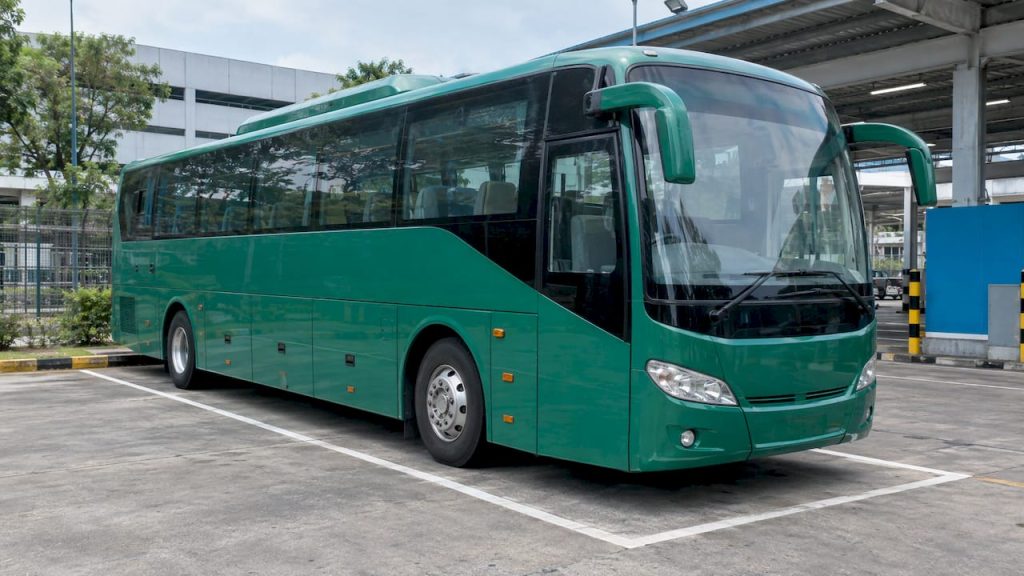
Larger groups. When a delegation, a patient’s extended family or a medical tour party travels together, a minibus or coach keeps everyone in one vehicle. For events or conferences held around medical congresses, see our guides to conference delegate transport and conference shuttle planning. Group vehicles should be booked well ahead, particularly if the arrival coincides with a busy period.
Cross-border and ferry arrivals. Some visitors reach Singapore from Johor or the nearby islands. We run ferry terminal transfers and cross-border transport to Malaysia, including Johor and Malacca. Our published charter vehicle rate is S$450 per day, as listed on our Malaysia rates page.
Rules and safety: what to check before you book
Singapore regulates both ambulance-type and ordinary point-to-point transport, and knowing which applies protects you.
Medical transport. MOH regulates private ambulances as either Emergency Ambulance Service or Medical Transport Service, licensed under the Healthcare Services Act from 3 January 2022. Providing these services without a licence is an offence with a fine of up to $100,000 or imprisonment of up to two years. MOH advises the public to engage only licensed providers, and to ask about charges or check published common charges beforehand. Licensed providers must have a clinical governance framework, trained crew and properly equipped vehicles.
Ordinary point-to-point transport. LTA’s framework, introduced in October 2020, licenses taxi operators and ride-hail operators, and all must meet LTA’s safety and quality standards. Chauffeured private hire cars must display tamper-evident decals on the front and back windscreens. Look for them when your car arrives.
A quick checklist before confirming any booking:
- Does the patient need clinical care in transit? If yes, use a licensed MTS or EAS.
- Is the vehicle suitable for the passenger’s mobility, and has the operator been told in advance?
- Are the price, vehicle type, waiting time and extra charges (such as late-night fees) confirmed in writing?
- Do you have the hospital’s address, entrance and appointment time to give the driver?
- Do you have the driver’s and the company’s contact number for flight delays?
What it costs
Medical transport and chauffeured transport are priced very differently, so compare like with like. MOH publishes fee ranges for private ambulances: a one-way transfer to A&E in office hours is $110 to $600 for EAS and $0 to $1,295 for MTS, with the MTS median at $325. These figures reflect clinical crew and equipment.
Our chauffeured services are priced per trip, per hour or per charter, according to vehicle type, group size and the service chosen:
| Service | Published rate |
|---|---|
| Airport arrival | S$65 to S$140 per trip |
| Airport departure | S$60 to S$130 per trip |
| Point-to-point transfer | S$60 to S$130 per trip |
| Hourly booking | S$50 to S$100 per hour |
| Midnight charge | S$10 to S$20 extra |
| Charter vehicle (Malaysia page) | S$450 per day |
The full list is on our rates page.
Book a calm, on-time transfer with Kler Transport
We provide chauffeured private transport across Singapore: Changi arrivals with meet-and-greet, luggage handling, experienced English-speaking drivers, and hourly or per-trip bookings for hospital days. Our fleet runs from sedans to minibuses and coaches, so a solo patient or a whole family is covered. Tell us your flight, hospital and mobility needs and we will recommend the vehicle.
See our transport services or go straight to the booking form.
FAQ
Can I use a normal chauffeured car if the patient is unwell?
Yes, if the patient can sit in a regular seat and does not need monitoring or medical equipment on the way. If they need clinical care, a stretcher or oxygen in transit, use a licensed Medical Transport Service. Ask the treating doctor which applies.
Do Singapore hospitals offer airport pickup?
Not necessarily. National University Hospital, for one, says airport transfers are not available and suggests taxis, private-hire vehicles or the MRT. Check your hospital’s international patient page, and consider pre-booking a private transfer for arrival.
What should I do in a medical emergency in Singapore?
Call 995 for life-threatening situations such as chest pain, loss of consciousness, severe bleeding, stroke symptoms or major trauma. Do not wait for a pre-booked car or a taxi.
How do I know a medical transport provider is legitimate?
MOH says to engage only providers licensed under the Healthcare Services Act, and to ask about charges beforehand. For ordinary chauffeured cars, look for the tamper-evident decals required on private hire cars.
Is hourly booking better than single trips on appointment days?
Often, yes. If you have a consultation, a pharmacy stop and a return to the hotel, one car and driver on an hourly booking avoids rebooking between each stop. Tell us the schedule when you book.
Sources
- LTA | Getting Around
- NUH patient and visitor guide for international patients
- MOH | Private Ambulance Services
- MOH newsroom: private ambulance operators to be licensed
- Healthcare Services (EAS and MTS) Regulations 2022
- Ministry of Transport | Taxi and private hire car
- LTA | Private Hire Car Licence
- SGH | MRT, Public Bus & Taxi
- SGH | Taxi Services
- Changi General Hospital | Getting to CGH
- TTSH | How to get to TTSH
- Thomson Medical | Shuttle Bus
- LTA | An Inclusive Public Transport System
- Guidelines for Safe Transport on Wheelchair-Accessible Vehicles
- AIC | Medical Escort and Transport